Repeating the same recipe isn’t boring. It’s how you become a better cook.
For the past couple of decades, my family has asked me each day, "What's for dinner?" and the weight of that question has grown heavier over time.
Article content
We independently select everything we recommend. Buying through us may earn us a commission, which supports our work.
See more Toronto Sun on Google — save as a Preferred Source
Advertisement 2

Article content
I own 146 cookbooks.
Article content
Article content
As a food writer, and recipe tester and developer, it’s probably not unreasonable that I have an extensive library of cookbooks, many of which are devoted to specific techniques and cuisines that I use for reference in my work. On a given night, I could turn to any one of these books to make Maryam Jillani’s spicy mint chutney to spoon over a protein; pull together Michal Korkosz’s potato dumplings, known as kopytka; or try my hand at vegan sushi.
But there was a period of my life when I ate the same meal four nights a week, and I’ve recently begun to yearn for it again. It’s the simplicity that I crave, and when I wrote about this topic in my Substack newsletter, the Kitchen Confessional, I was struck by a comment from cookbook author Irina Georgescu when she shared my original post with her readers: “A bit like Einstein and his suits. Routine frees your mind from the stress of constantly having to choose or make decisions.”
Look, I’m not comparing myself to Albert Einstein, who famously filled his closet with identical suits so that he could preserve his brain power for more important things, like the theory of relativity, but it started me thinking. Does simplifying our menus give our brains breathing room, and does repeating the same meal multiple days each week have to be boring?
Advertisement 3
Article content
The more I thought about taking this “Einstein approach” in the kitchen, the more it occurred to me that there are real benefits to repetitive cooking. For the novice cook, it offers an opportunity to master a single dish, thereby building confidence so they can then swap in different ingredients as needed for a new twist on the same recipe. At the same time, that consistent practice helps build muscle memory in the kitchen, allowing for both speed and ease in preparation. The daily meal is suddenly no longer a mystery to be solved, just a dish to be savoured.
For the past couple of decades, my family has asked me each day, “What’s for dinner?” and the weight of that question has grown heavier over time. Like many home cooks, I often felt the pressure, perhaps coinciding with the early days of the Food Network, to produce something new and different for dinner each night as I cooked along with Sara Moulton on her “Cooking Live” show, kicked the spices up a notch with Emeril Lagasse, and adopted Rachael Ray’s “garbage bowl” for keeping my countertop tidy. As a Gen Xer, I had grown up seeing my own mom come home from work each day to cook along with Julia Child and Graham Kerr, never repeating the same dish twice in a week, and that seemed like the natural order of things.

Your Midday Sun
Article content
Advertisement 4
Article content
But when I first got married, my husband was an early-career journalist who worked late most weeknights, which often left me cooking dinner for just one. One night, tired after my own workday and lacking energy for a grocery store run, I scoured the pantry for ingredients, emerging with angel hair pasta, dried currants and pine nuts. I’m not sure what it was about that trio, but the combination worked, so I went back to it the next night with a few tweaks.
I started by toasting the pine nuts just until golden, removing them to cool while using the same pot to cook the pasta. In the last minute of cooking, I threw in a handful of dried currants to plump up and reserved some of the pasta water before draining. Then, with the drained pasta, currants, pine nuts, red pepper flakes and parmesan cheese added to the pot, I added a healthy glug of olive oil and a splash of that reserved water, quickly stirring until it was all coated with a glossy sauce. Eventually, as I continued to make the same dish each night, a little garlic powder and a sprinkling of fresh parsley rounded it out.
Advertisement 5
Article content
Sweet, salty, nutty, garlicky, herbaceous, a hint of spice. Perfection.
So perfect, in my mind, that I happily ate this same pasta dish a few nights a week – for several years. And while I adored the combination of currants and pine nuts, it was also easily adaptable to any other odds and ends in my kitchen: finely chopped dried figs and Kalamata olives, toasted almonds, a squeeze of fresh lemon juice, leftover cherry tomatoes and garbanzo beans, crumbled blue cheese – all fair game while keeping the same basic flavor profile, with enough variety to keep things interesting. And because my starting point was angel hair pasta, which cooks to al dente in about four minutes, I could reasonably dish up dinner in under 15 minutes once I got the routine down. It wasn’t a revolutionary recipe in itself, it just took the guesswork out of mealtime.
I largely abandoned that dish after my daughter was born. Perhaps it was the feeling that I should introduce her to a lot of different foods. Or maybe I wanted to be Supermom, cooking up a range of flavorful meals every day, including peanut tacos, aloo gobi and pad thai.
Advertisement 6
Article content
In recent years, we’ve begun to recognize the “cognitive labor” that largely falls to women, in which they become, as psychologist Jelena Kecmanovic puts it, the “de facto CEOs of their family … planning meals, updating grocery lists, communicating with kids’ schools and babysitters, and organizing family outings.” When my family declares, as they stare into the open refrigerator, that there’s “nothing to eat,” I can, even over the phone, list half a dozen options. My brain is consistently crowded with itemized lists of what food is in the house, what has to be replenished and what ingredients are needed for a specific recipe.
Did Einstein know what was in the refrigerator? I’m guessing not – he is said to have married his second wife, Elsa Löwenthal, primarily because he wanted a companion who would manage the household so he could focus on his work. Elsa handled the cognitive labor.
On a recent night, when my husband was going to be working late, I suddenly realized I had all the ingredients for my old angel hair pasta standby. Just as I was about to make it, Rick called to say that he was heading home early – and asked about dinner. Hesitating, I said, “I was just about to make this pasta dish, but I don’t think you’ll like it.” Prodding me for more details, he replied: “It sounds delicious. I’d love to have that, too, if you don’t mind making enough for both of us.”
Advertisement 7
Article content
So I did. And it was a hit. Will he eat it four nights a week? Maybe not, but it could go into the regular rotation. Like Einstein, I’ve got other things to think about.
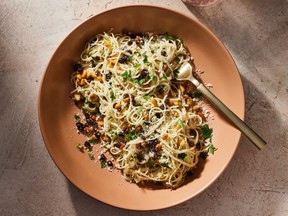
Angel Hair Pasta With Currants and Pine Nuts
Servings: 2-3 (makes about 5 cups)
Total time: 35 mins
Sweet, salty, nutty, garlicky, herbaceous, with a hint of heat – all these elements are found in this one simple pasta. Created from what food writer Kristen Hartke had available in her pantry one night, this dish became an almost-daily mainstay for the first few years of her marriage, when she needed to cook a fast meal for one while her husband was working late – although it works just as well for a crowd.
Storage: Refrigerate for up to 4 days.
INGREDIENTS
1/2 cup (2 ounces) raw, unsalted pine nuts
1/2 teaspoon fine salt
8 ounces dried angel-hair pasta
1/2 cup (2 ounces) dried currants
1/4 cup (1/2 ounce) grated parmesan cheese, plus more as needed
3 tablespoons extra-virgin olive oil
1 tablespoon finely chopped fresh flat-leaf parsley, plus more as needed
Advertisement 8
Article content
1 teaspoon crushed red pepper flakes, or to taste
1/2 teaspoon flaky sea salt, such as Maldon
1/2 teaspoon garlic powder
1/2 teaspoon freshly ground black pepper
DIRECTIONS
Step 1
Heat a medium (3-to-4-quart) pot or Dutch oven over medium heat until hot. Add the pine nuts and toast, stirring frequently, until fragrant and golden, 3 to 5 minutes. Remove from the heat and transfer the nuts to a small plate. Let the pot cool for a few minutes before proceeding.
Step 2
Fill the same pot with water, set it over high heat and bring to a boil. Add the fine salt, followed by the pasta, and cook according to package directions until al dente. About 1 minute before the pasta is ready, add the dried currants. Reserve 1/2 cup of the pasta cooking water, then drain.
Step 3
Return the pasta and currants to the same pot, then add the pine nuts, parmesan, oil, parsley, red pepper flakes, flaky sea salt, garlic powder and black pepper, and toss thoroughly to incorporate. As you’re tossing, add the reserved pasta water as needed, 1 tablespoon at a time, to create a glossy sauce. You may not need all the water.
Advertisement 9
Article content
Step 4
Divide among bowls, top with more parmesan and parsley, if desired, and serve immediately.
Substitutions: Currants >> raisins or finely chopped figs. Pine nuts >> chopped cashews, walnuts or almonds. Nut-free? >> Toast panko in a little olive oil instead. Fresh parsley >> basil. Gluten-free? >> Use gluten-free pasta. Dislike heat? >> Use less crushed red pepper, or omit. Dairy-free? >> Use nondairy parmesan.
Nutritional facts per serving (1 2/3 cups,) based on 3: Calories: 591, Fat: 30 g, Saturated Fat: 4 g, Carbohydrates: 74 g, Sodium: 481 mg, Cholesterol: 4 mg, Protein: 14 g, Fiber: 4 g, Sugar: 15 g.
This analysis is an estimate based on available ingredients and this preparation. It should not substitute for a dietitian’s or nutritionist’s advice.
From food writer Kristen Hartke.
Article content