For young Canadians, there are many pathways to pro baseball
There is no single blueprint to follow — only years of work and a belief that a player's own path would be enough.
Article content
Jolene Latimer
Advertisement 2

Article content
Special to the Sun
Article content
Article content
It was an impressionable time to be a seven-year-old Blue Jays fan. In the fall of 2015, Toronto was in the post-season for the first time in Elliot Lascelles’ lifetime. It was the year many Canadians remember for the Jose Bautista bat flip. Lascelles didn’t see it live. It was past his bedtime.
“I don’t remember actually seeing the moment but it definitely had a big impact on me,” he said.
The momentum around the Jays spread through classrooms and Little League dugouts, stoking a love of baseball in Lascelles that had been building since he asked Santa for a glove three years earlier, a gift that had ignited an obsession with playing catch, then T-ball, and then eventually organized baseball.
It would take him a few more years to build up the stamina for October baseball. The next year, when he started falling asleep in the stands at Rogers Centre, his mom took him home early.
“He missed the Edwin Encarnacion walk off home run in the wild card game against the Orioles,” said his dad, Eric Lascelles.
Advertisement 3
Article content
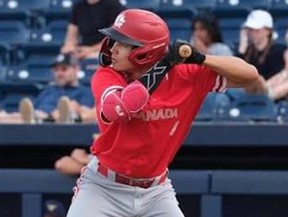
Bedtimes eventually became later and there were no more early exits after that. His amateur baseball career blossomed; in 2024 he joined the junior national team while also playing for the Toronto Mets of the Canadian Premier Baseball League. And now he has gone from watching the pros to belonging among them. This July, 18-year-old Lascelles was drafted by the San Diego Padres in the second round (60th overall), signing a $2.8 million deal, the highest ever for a Canadian position player.
“A lot of people told me if teams are really interested in you out of high school it’s a good opportunity because they’ll invest in you and it could be the best advantage going to pro ball at a younger age,” Lascelles said.
Lascelles, who de-committed from Yale to sign with the Padres, was not the only Canadian in the MLB draft this year. Carter Beck an outfielder from Carnduff, Sask., was drafted 26th overall by the Atlanta Braves, and Sean Duncan, a left-handed pitcher from Port Coquitlam, B.C., went in the second round, 63rd overall, to the New York Yankees. Together, they represent not just the strength of Canadian baseball, but the many paths to the professional ranks.

Your Midday Sun
Article content
Advertisement 4
Article content
“There’s been a lot of things for baseball in Canada that are trending upward and the amount of Canadians drafted this year has shown what those things can do for Canadian baseball,” said Lascelles.
When Greg Hamilton took over Baseball Canada’s junior national program in 1999, a position he still holds today, he quickly began creating opportunities for the junior national team to compete against professionals. Not only was he looking to overcome barriers to training presented by the long, Canadian winters, but he was driven by a firm belief that to get better, you have to play those who are better.
“There’s really no substitute to being a talented player and being in an environment that’s professional. The speed of the game forces them to adjust, grow, embrace it and develop,” he said.
Hamilton has grown the initiative from what was an extended pro trip in April to playing in the Dominican Summer League in May and playing a fall schedule against pro players. Today, high school players on the U18 team will play upwards of 30 to 40 games annually against pros.
Advertisement 5
Article content
It’s one of the reasons some posit Canada has been more successful in baseball lately; in 2026, Canada reached the quarterfinals of the World Baseball Classic for the first time.
The trips can also test the resilience of some players. It was during one of these pro trips this spring that Sean Duncan injured his arm. Duncan’s mom, Lisa, was watching updates of the game online and saw he was pulled, with no explanation why.
On the ground in the Dominican Republic, Hamilton already had a suspicion of what had gone wrong. It was the third out of the inning. A fastball.
“I got a little concerned in terms of how the ball was coming out of his hand in the inning where it occurred,” he said.
Duncan had felt a pop in his elbow. When he indicated he was hurt, Hamilton pulled him out of the game. “I immediately switched to trying to help a young man deal with incredible adversity and disappointment,” he said.
Imaging results the next day showed Duncan would need an internal brace surgery to correct the injury — not a full Tommy John surgery but still a significant blow ahead of the draft.
Advertisement 6
Article content
“It’s definitely easy to think, ‘Why me?’ But in my case that never happened,” said Duncan.
Instead, he immediately put his mind toward next steps. Not even 24 hours after the surgery, he was in Arizona at the MLB Draft Combine.
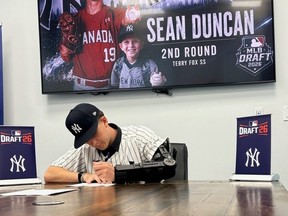
Duncan had fallen in love with baseball early.
“From when I was six years old to 12, every time my dad would get home, I’d ask if we could throw in the backyard,” he said.
He played other sports, too — basketball, karate and soccer. Not hockey. “I might be the only Canadian who can’t skate. Even after private lessons,” he said. But it was baseball that captured his attention.
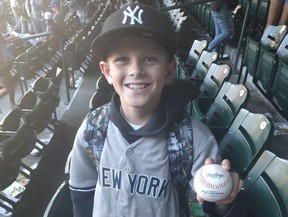
He inherited a love of the Yankees from his dad and still remembers their annual visits to Seattle to watch the team on their western road trips. His favourite Yankee was three-time all-star Aroldis Chapman, the team’s closer.
“By luck, he got in the game in the ninth inning and threw a ball that was a foul ball. It came right into my glove. I caught the foul ball and I was like, ‘Oh my gosh, Aroldis Chapman just threw this ball and now it’s in my glove,’ ” he said. The ball still lives in Duncan’s room at his parents’ house in B.C., where he lived throughout high school, despite offers to attend prestigious academies stateside.
Advertisement 7
Article content
Like many elite youth athletes, Duncan was courted by these schools that promised access to superior training and development opportunities that could translate into professional success. He said no, opting to stay local and play for the Langley Blaze in the B.C. Premier Baseball League.
“Some of these academies are really impressive, like, ‘Oh wow, celebrities’ kids go to them,’ ” said his mom, Lisa Duncan. “But I’ve always thought, ‘For what?’ ”
She said the opportunities with the Blaze and Team Canada seemed sufficient for his growth.
“If he’s good, he’s good. If he’s not, I’m not giving him up early. So, he’s going to stay at home,” she said.
It turns out Duncan was good and the right people took notice. He committed to Vanderbilt University before he was drafted. And the injury didn’t scare away the Yankees, who have a strong track record of rehabbing athletes from similar surgeries. After being selected by New York in the second round, Duncan signed a $2.49 million deal to go pro and is now rehabbing in Florida at the team’s player development complex.
Advertisement 8
Article content
“When my name was called and I figured out it was going to be the Yankees it was that much sweeter just because I had dreamt about it my entire life,” he said.
For Hamilton, Duncan and Lascelles are cut from the same cloth, even if they took different routes to the draft.
“Both Elliot and Sean have a parallel make up — they’re both intelligent, exceptionally talented in baseball, work ethic is tremendous, compete level is tremendous, they kind of marry everything together. You have the physicality, the athletic ability, and you put that with the makeup, the drive and resiliency and they’re special players,” said Hamilton.
It’s not a coincidence, he said, that both were drafted this year. “The game has never really been better in terms of the coaching and the programming,” he said. “There are more and more Canadians who are excelling at the highest levels of the game”
Success in Canadian baseball doesn’t have to mean playing for the national team or getting drafted directly out of high school.
Advertisement 9
Article content
“I knew I wasn’t going to get drafted out of high school. When I was in high school, I didn’t even know I was ever going to get drafted,” said 21-year-old Beck, who became the highest drafted Saskatchewan player when he went 26th overall this year. He signed with the Atlanta Braves for $2.68 million.
Many of the small towns dotted across Saskatchewan can claim at least one NHL player who was born and raised on their streets, but not so for Carnduff, the 1,200-person town not big enough to have any stoplights. Yet it was in Carnduff, in the most southeastern corner of the province and just 20 minutes north of the U.S. border, that Beck’s professional sports dreams began, as a four-year-old on the local baseball diamond fielding his dad’s foul balls.
“He’d play catch with other guys on the team and just be around the team. You could definitely tell he had natural skill and a capacity to get better,” said his dad, Blair Beck.
Like Lascelles, Beck was swept up in the momentum of the Blue Jays in 2015. “I remember it all. It was a ton of fun to watch,” he said. That jump-started an interest in baseball, but he continued to play all sports throughout high school.
Advertisement 10
Article content
“I wasn’t too worried about specializing in a sport. I knew I was going to pick baseball, but I wasn’t going to give up hockey. I still played volleyball in the fall and ran track in the spring. I wasn’t giving up those sports either. I was doing whatever I could and building an athletic base,” he said.
In a sporting atmosphere where children are increasingly pressured to specialize, Beck and his parents believe playing multiple sports became his advantage.
“I think it’s the reason we’re talking about him right now. As a kid, he was not a good runner. We were lucky at school we had teachers come through who were athletes themselves and we had some track people who were really able to help him. He honed his competitive edge in hockey, his leadership skills. In volleyball, he got to work on explosiveness and being part of a team and competing. All of those things played a role in who he is today,” Blair Beck said.
They also balked at the idea of sending him away to an academy during high school.
Advertisement 11
Article content
“It’s hard for parents. It’s a lot of pressure and you don’t really know what is the best thing to do. We just always try to look at whatever our circumstances were and try to make the best decision we could,” said his mom, Tara Beck.
They decided Carnduff would have to be enough for Beck — and it was.
“There was everything you needed there,” Beck said. “There was a little gym where I could work out called The Sweatshop, it got the job done. And if I ever needed access to the school gym or anything like that, I could go in.”
Beck’s dad taught grades 7 to 9 in the town and unlocked the school for him at times — they lived just two blocks away.
“It’s not the nicest of facilities, but it was enough,” Beck said.
In high school, he juggled playing Triple A in nearby Estevan with his studies and a part-time job at an auto body shop.
“I’d definitely say I do a lot of things on the more old school side of things. But I mean, it’s worked out for me,” he said.
Following graduation, he moved to North Dakota to play NCAA DII baseball at the University of Mary before transferring to Indiana State University as a sophomore. It was after his first season in Indiana that his coach leveled with him.
Advertisement 12
Article content
“If you don’t get drafted next year, we’re going to have a problem,” Beck remembers him saying.
That was the first time the possibility of getting drafted felt real to him. This summer, it went from possibility to reality.
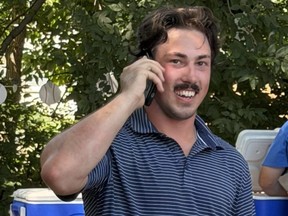
Beck gathered about 40 friends and family from Carnduff in his parents’ backyard to watch the draft. He was socializing and missed a few phone calls. When he finally answered his phone, his agent told him he was getting drafted imminently.
“I walked to the backyard, pointed at the TV and then all of a sudden they announced it,” he said.
He put his hands on his head and was “absolutely speechless.”
“Talking about it still gives me goosebumps,” he said. “It’s just one of the most surreal feelings I’ve ever had. I did not know how to act.”
Because he was selected earlier than expected, some of the guests hadn’t even arrived yet. Later that night, he issued an open invite for supporters to come to the baseball diamond to celebrate with a BBQ and cake. It was the same diamond he had fielded foul balls at all those years before. Close to 200 people turned up. Most of them had watched Beck grow up.
Advertisement 13
Article content
Remembering the day still makes Beck’s mom Tara start to tear.
“It’s very exciting when you see your kid have some success with all the hard work they put in,” she said.
Beck knows there are many more levels to the game, and he will have to work hard to crack a major league roster. But it’s all part of the process.
For Beck, as for Lascelles and Duncan, there was no single blueprint to follow — only years of work and a belief that his own path would be enough.
“The biggest thing I’ve learned through this is to have your dreams, but keep working on them. Then your dreams start to become your goals. Once your dreams become goals, then you’ve just got to dream bigger. There are no shortcuts. There’s no secret answer,” Beck said.
Article content